After nearly 15 inspiring years at the Guardian, I will be leaving at the end of May to join the Twitter media team in San Francisco as its first Data Editor.

A lot has changed since 1998 when I joined as editor of NewsUnlimited, the then-titled GuardianUnlimited’s news section.The front page of the site looked like this:
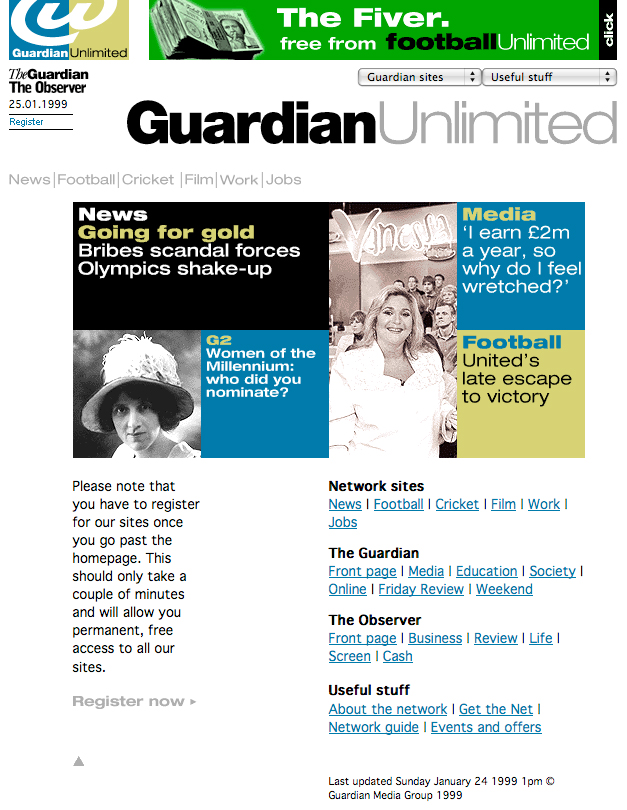
gucom

Since then, there has been a revolution in the way news is presented and absorbed. I moved to the newspaper newsdesk on September 10, 2001. The events of the next day and the months after created an unprecedented demand for instant news and analysis. On a personal level, it changed my career path: before then I saw stories in terms of words; working with the Guardian’s graphics team in the aftermath taught me that there were new ways to tell those stories and that data journalism was one of the most effective.

All news organisations are struggling with challenges to what they thought they were. The newspaper’s traditional one-way relationship with readers has been replaced by a new equality where stories are broken by anyone with a mobile device. It’s a process that we’ve seen in Boston this week. Just listen to this excellent Steve Richards documentary to see how news gathering has been transformed.

The Guardian has embraced this new open journalism with enthusiasm. Editor Alan Rusbridger encouraged my setting up the Datablog in 2009 and has championed our work in data journalism. It must have seemed a little odd to want to create a site which would allow users to download and analyse datasets such as public spending figures for themselves. Traditionally that was the reporter’s job – why would we share it? The point was to democratise that data; it belongs to everyone, after all.

During my time at the Guardian, I have been fortunate to work with some of the greatest journalists you could ever meet – from the reporters and columnists to the desk editors and designers who lead the world in what they do. It’s a wrench to leave the Datablog – and a talented team in Ami Sedghi, John Burn-Murdoch and James Ball (who will take on editing the site, and be brilliant).

Twitter has become such an important element in the way we work as journalists. It’s impossible to ignore, and increasingly at the heart of every major event, from politics to sport and entertainment. As data editor, I’ll be helping to explain how this phenomenon works.

And I can’t imagine a better job than getting to tell stories based on some of the most amazing data around.

35 responses to “Farewell Guardian, hello Twitter”

  1. […] 在其一篇名为《再见,卫报,Twitter 你好》的博文中提到,Twitter […]

  2. […] the founder of The Guardian’s data blog, was hired by Twitter in 2013 to be the company’s first data […]

  3. […] in 60 seconds Gut gemachte Zeitrafferaufnahme aller Tweets zu Sotschi. Man merkt, dass Twitter mit Simon Rogers, vorher beim Guardian, einen echten Datenexperten an Bord […]

  4. […] fazem, falam e compartilham na rede social.O escolhido para a função é o jornalista inglês Simon Rogers, que trabalha há 15 anos no prestigioso jornal The Guardian. Na publicação britânica, Rogers […]

  5. How disappointing a highly trained and talented journalist leaves a quality newspaper for the La-La news world of Twitter. People like me will never transition to digitized news on a screen because it is such a bother. The printed world remains superior to the digitized junk information universe in the techno-sphere.
    Digitized information on a screen mediated by machine can’t be touch and smelled. It is simply awkward. In our house we have established the practice of NO DIGITIZED MEDIA. If it isn’t printed on paper, we don’t traffic in it. One would be surprised how such a policy centers us on essential news in easy to read formats. It cuts out so much superfluous information. In my opinion Simon Rogers is going in the wrong direction.

  6. […] Simon Rogers è stato assunto da Twitter come data editor, Facebook continua ad arruolare data scientist e i corsi di datajournalism europei aumentano, fuori o dentro le università. E per molti giornalisti, finalmente Excel inizia a rappresentare qualcosa in più di una griglia per commercialisti. […]

  7. […] já uma das principais histórias do ano: depois de 15 anos, Simon Rogers saiu do The Guardian para se juntar ao Twitter como o seu primeiro Editor de Dados. O criador do conhecido Data Blog deixa o Reino Unido como um […]

  8. […] already one of the top stories of the year: after 15 years, Simon Rogers left The Guardian to join Twitter as its first Data Editor. The creator and editor of the Data Blog leaves the UK as one of the most established and respected […]

  9. […] Guardian Datablog Simon Rogers reported on his blog today that he’s leaving the paper to work for Twitter as a data […]

  10. […] ちなみにロジャーズさんは、5月いっぱいでガーディアンを去り、米ツイッターに新設されるデータエディターに就任しするという。これはこれで、びっくりするニュースだ。 […]

  11. […] Rogers, der Kopf hinter dem Datablog des Guardian, das er 2009 startete, verlässt London in Richtung San Franscisco. Dort wird er “Data Editor” bei Twitter. Sein […]

  12. […] di cui gli ultimi 4 spesi a capo del Datablog, il 18 aprile Simon Rogers ha annunciato con un post il suo passaggio dal quotidiano inglese al sito di microblogging Twitter come suo primo data […]

  13. […] JOURNALISM AWARDS y una nueva profesión, la de DATA EDITOR. El primero: Twitter ha contratado a Simon Rogers, ex editor de noticias y periodista de datos en The Guardian, para ser su primer editor de datos. […]

  14. […] invitato, quasi due mesi fa, nessuno sapeva; è stato ancora più interessante averlo poco dopo che ha annunciato la sua scelta); Robert Hernandez, docente alla USC e Kerstin Shamberg, senior social media manager (a 29 anni, […]

  15. […] Below is what Rogers wrote about his new job in a blog post. […]

  16. A very nice move for Twitter and (assuming) for you. Keep dataloving 😉

  17. […] imagine a better job than getting to tell stories based on some of the most amazing data around.», schreibt er dazu auf seiner Website. Seine Position beim Guardian wird James Ball […]

  18. […] data editor, I’ll be helping to explain how this phenomenon works,” Rogers wrote in a blog post on his new […]

  19. […] data editor, I’ll be helping to explain how this phenomenon works,” Rogers wrote in a blog post announcing his new […]

  20. […] Nuevo jale. Simon Rogers, editor de Data Blog, del diario The Guardian, asumirá el puesto como editor de datos en la red social Twitter a fines de mayo. Así lo anunció a través de su página web personal. […]

  21. […] data editor, I’ll be helping to explain how this phenomenon works,” Rogers wrote in a blog post on his new […]

  22. […] escolhido para a função é o jornalista inglês Simon Rogers, que trabalha há 15 anos no prestigioso jornal The Guardian. Na publicação britânica, Rogers […]

  23. […] such an important element in the way we work as journalists,” Rogers said on his personal blog. “As data editor, I’ll be helping to explain how this phenomenon works.” – […]

  24. […] announced he will leave the Guardian to take the first data editor position at Twitter. In a post on his personal blog, Rogers reminisces on his time at the Guardian and looks forward to his new […]

  25. […] in the context of Twitter and the news, I note that Guardian Datablog editor Simon Rogers is going to work for Twitter… I also spotted a few days ago that ex-of the Guardain data intereactive designer Alastair […]

  26. […] einem Blogbeitrag führt der neue Mann bei Twitter aus: “Twitter ist so ein wichtiges Element unserer Arbeit […]

  27. […] öffentlich bekannt. In seinem Blog berichtet Rogers über seinen Wechsel unter der Überschrift Farewell Guardian, hello Twitter. Künftig wird es also vieleicht ein Kinderspiel sein auf alle relevante Informationen auf Twitter […]

  28. […] data editor, I’ll be helping to explain how this phenomenon works,” Rogers wrote in a blog post on his new […]

  29. […] data editor, I’ll be helping to explain how this phenomenon works,” Rogers wrote in a blog post on his new […]

  30. […] data editor, I’ll be helping to explain how this phenomenon works,” Rogers wrote in a blog post on his new […]

  31. […] data editor, I’ll be helping to explain how this phenomenon works,” Rogers wrote in a blog post on his new […]

  32. […] data editor, I’ll be helping to explain how this phenomenon works,” Rogers wrote in a blog post on his new […]

  33. […] data editor, I’ll be helping to explain how this phenomenon works,” Rogers wrote in a blog post on his new […]

  34. […] Farewell Guardian, hello Twitter, simonrogers.net […]

  35. […] Rogers, who has been an employee at The Guardian for 15 years, setting up the Datablog back in 2009, winning a number of awards for his data journalism, will be working at Twitter in a newly-created position. Rogers has been writing about his expectations for the move – and his experiences at The Guardian – on his blog. […]

Leave a comment

Get the Book

Take a trip inside the world’s brain. Out May 2026

Go back

Your message has been sent

Warning

Published May 2026: What We Ask Google

Take a trip inside the world’s brain. Discover the definitive family portrait of the twenty-first century, revealing how we are interconnected by the honest questions we ask every day